2026 Mazda CX-5 review
Mazda has rebuilt its biggest seller from the ground up and the third-generation CX-5 is bigger, quieter and more polished than ever. The only thing missing is the powertrain everyone is waiting for.

Rob Leigh


Pros
- Genuinely fun to drive with sharp steering and barely any body roll
- Bigger, quieter cabin that punches well above its price
- AWD standard across every grade, priced to undercut hybrid rivals
Cons
- No hybrid until 2027 at the earliest
- Almost every control now lives in the touchscreen
- Real-world fuel use lags the segment's petrol-electric leaders
Our verdict
This is a family SUV for the buyer who still cares how a car drives, wrapped in a cabin that’s finally worth the money. It does refinement, handling and value better than almost anything in the class. The catch is fuel, because the hybrid that would complete the package is still a year or two away.
What does the Mazda CX-5 cost in Australia?
The CX-5 range runs to five grades, from the Pure at $39,990 before on-road costs to the flagship Akera at $54,990. Every grade shares the same 2.5-litre petrol engine, six-speed automatic and all-wheel drive, so stepping up buys you equipment rather than performance.
Standard AWD is the headline. It’s rare at the entry end of the medium SUV class, and it goes a long way to justifying price rises of up to $2750 over the old car.
Mazda knows it's competing against some excellent hybrids, so pricing the petrol-only CX-5 competitively is important. Until the hybrid arrives, value is one of its biggest selling points.
| Specifications | Pure | Evolve | Touring | GT SP | Akera |
| Price excluding on-roads | $39,990 | $42,990 | $47,490 | $51,990 | $54,990 |
| Powertrain | 2.5L petrol | 2.5L petrol | 2.5L petrol | 2.5L petrol | 2.5L petrol |
| Power | Torque | 132kW | 242Nm | 132kW | 242Nm | 132kW | 242Nm | 132kW | 242Nm | 132kW | 242Nm |
| Transmission | 6 speed auto | 6 speed auto | 6 speed auto | 6 speed auto | 6 speed auto |
| Drivetrain | AWD | AWD | AWD | AWD | AWD |
| Fuel use (claimed) | 7.4L/100km | 7.4L/100km | 7.4L/100km | 7.4L/100km | 7.4L/100km |
| Braked towing | 1800kg | 1800kg | 1800kg | 1800kg | 1800kg |
| ANCAP | Five stars (2026) | Five stars (2026) | Five stars (2026) | Five stars (2026) | Five stars (2026) |
| Warranty | 5 years | Unlimited km | 5 years | Unlimited km | 5 years | Unlimited km | 5 years | Unlimited km | 5 years | Unlimited km |
View Mazda CX-5 driveaway pricing and specifications →
The Evolve is the pick of the range. For $3000 more than the Pure it adds heated front seats, wireless phone charging, wireless Apple CarPlay and Android Auto, keyless entry and rear air vents, which covers most of what a family will actually use.
The Touring adds 19-inch alloys, a 10-way powered driver’s seat with memory, a heated steering wheel and windscreen, a head-up display, a power tailgate and roof rails. It’s a lovely thing to live with, but it’s not where we’d spend our money.
The only options are trim upgrades. Black and white Maztex is $1000 on the Touring, and tan leather costs the same on the GT SP and Akera.
What does the Mazda CX-5 look like?
Mazda has played the long game with styling.
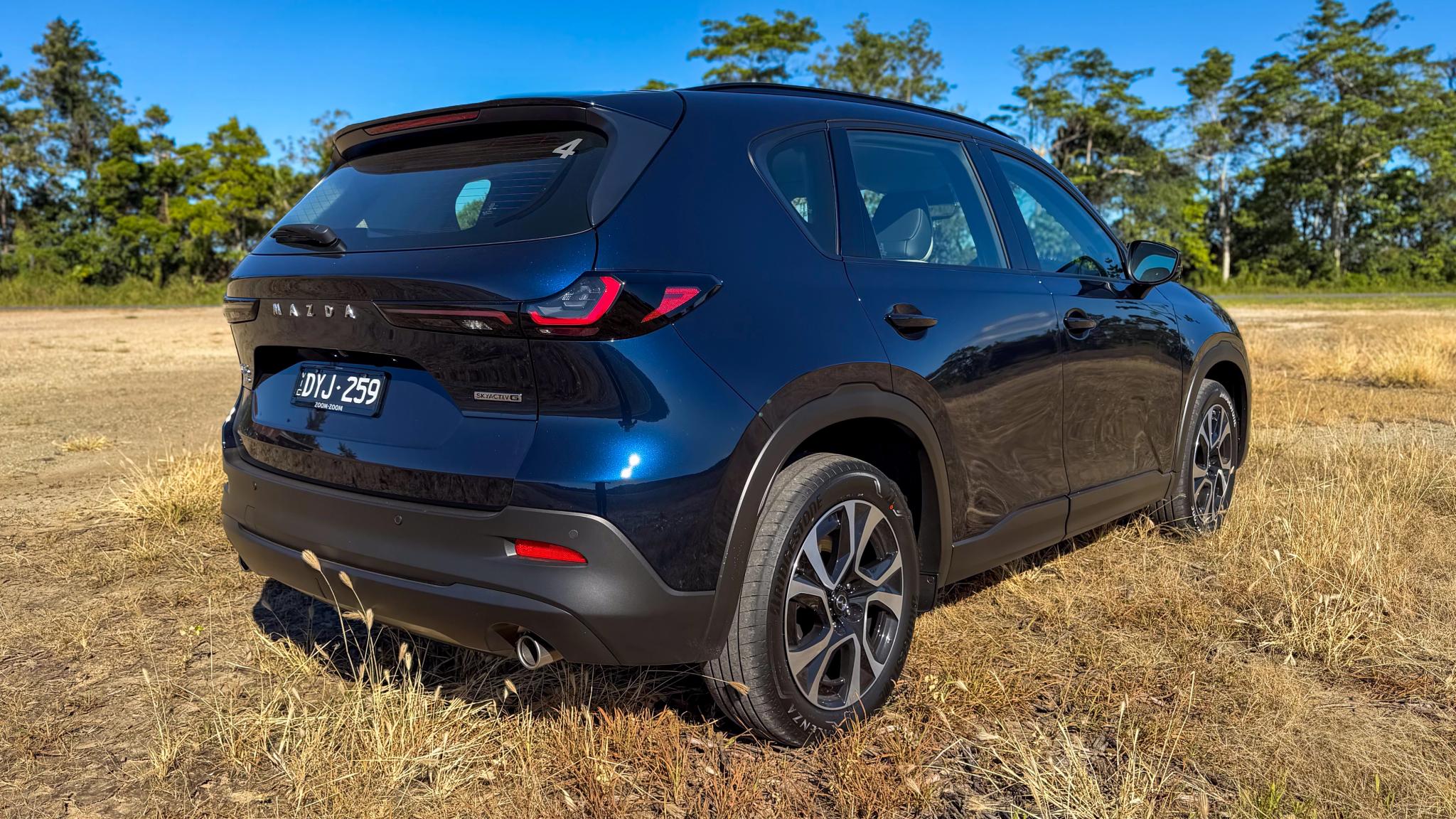
This is clearly a CX-5, just stretched, sharpened and given a more grown-up stance. At 4,690mm long on a 2,815mm wheelbase, it reads as one of the bigger options in the medium SUV class, and the longer rear doors and thicker C-pillar give it a more substantial, almost premium silhouette.
Mazda has also made some nice changes to the finer details.
Slim LED headlights, a full-width lower intake and the new MAZDA lettering across the tailgate lift it above the wallpaper of identikit family SUVs.
The Pure and Evolve ride on 17-inch wheels, with 19-inch alloys arriving from the Touring up and there is a fresh Navy Blue Mica if you want to step away from the inevitable Soul Red Crystal. It is handsome rather than shouty, which suits the brand.
What is the Mazda CX-5 like inside?
The interior is a big improvement over the old CX-5. The dashboard looks cleaner, the materials are excellent for the money and there's a genuinely premium feel throughout the cabin.
A 12.9-inch central touchscreen is standard with a 15.6-inch unit reserved for the Akera, and it is comfortably the best infotainment Mazda has ever fitted. It is crisp, quick and sensibly laid out, running a Google-based system with Mazda Connected Services baked in.
There is a catch, though, and it is a big one for some buyers: Mazda has gone almost fully touchscreen. The old rotary dial is gone and most functions now route through the display. There is logic to it, the menus are clean and a row of climate shortcuts stays visible, but anyone who loved the physical simplicity of the old car will need a short adjustment period.
Fit and finish are strong where it counts and only the occasional plain plastic surface hints at where the accountants got involved. Even so, the cabin feels like a clear generational leap.
How practical is the Mazda CX-5?
Finally, the CX-5 has the space to match its rivals.
The single biggest fix in this generation is rear-seat space, long the CX-5's weakest link. The stretched wheelbase opens up real legroom and headroom in the back, and the longer rear doors make loading kids and child seats far less of a contortion act.
Boot space grows too, up by around 61 litres to roughly 500 litres, with a versatile 40-20-40 split rear seat and a lower loading lip for bikes and prams. It still is not the outright cargo champion of the class, but it is no longer a reason to walk away.
Add the rear air vents from the Evolve up, sensible storage and the easy-access doors, and this is now a CX-5 that works as a genuine family car rather than one you tolerate for the way it drives.
What is the Mazda CX-5 like to drive?
Here is the good news for anyone who has ever enjoyed a Mazda: it still feels like one.
Find a winding road and you'll quickly remember why Mazdas are so good to drive. The steering is sharp, there's very little body roll and the CX-5 handles corners better than most family SUVs.
Standard AWD adds a reassuring layer of grip, and the ride is a clear step more compliant than before without going soft. Even on the 19-inch wheels fitted from the Touring up, it stays composed over scrappy suburban surfaces, and the cabin is impressively quiet at speed.
The Pure and Evolve ride on 17-inch wheels and are noticeably softer again. If ride comfort tops your list, those are the grades to pick.
The weak spot is muscle. The 2.5-litre petrol four makes 132kW and 242Nm on 91 RON, rising to 138kW and 257Nm on 95 RON, paired to a six-speed automatic.
It's smooth and has enough power around town, but overtaking with a full car takes some planning. The six-speed automatic works well enough, although a bit more power would make the CX-5 a much better car to drive.
How efficient is the Mazda CX-5?
Fuel economy is still one of the CX-5's biggest weaknesses. Mazda claims 7.4L/100km on the combined cycle, but in mixed real-world driving we saw between 8 and 9L/100km.
That’s fair for a petrol AWD SUV of this size. It still lands well behind the segment’s hybrid leaders, and that’s exactly the gap a hybrid CX-5 would close.
Mazda quotes the engine’s outputs on 91 RON regular unleaded. Filling up with 95 RON lifts them slightly, but the extra cost at the bowser only makes sense if you value the sharper response.
Mazda Australia has said the hybrid won’t arrive here before 2028. Until then, you buy the CX-5 in spite of its efficiency, not because of it.
Servicing is a genuine bright spot. Each visit is capped-price on 12-month or 15,000km intervals, and the new car costs less to service than the one it replaces. Cheaper minor services alternate with pricier major ones, so no single year stings, and the five-year total is keen for a medium AWD SUV.
| Servicing and Warranty | Mazda CX-5 |
| Service 1 (12 months | 15,000km) | $351.78 |
| Service 2 (24 months | 30,000km) | $525.41 |
| Service 3 (36 months | 45,000km) | $351.78 |
| Service 4 (48 months | 60,000km) | $620.27 |
| Service 5 (60 months | 75,000km) | $351.78 |
| Servicing cost (5 years) | $2201.02 |
| Average annual cost | $440 |
| Vehicle warranty | 5 years | Unlimited km |
The warranty and matching five years of roadside assistance are respectable, but no longer a selling point. Several rivals, particularly from Korean and Chinese brands, now offer seven years, so Mazda sits in the middle of the pack rather than out in front.
Is the Mazda CX-5 safe?
Very. The CX-5 carries a five-star ANCAP rating from 2026 that applies to every grade and runs until the end of 2031. That breaks down to 90% for adult occupants, 91% for child occupants, 93% for vulnerable road users and 87% for safety assist.
That vulnerable road user score is the standout. It’s the highest ANCAP awarded under its 2025 criteria, which says a lot about how well the CX-5’s front end protects pedestrians and cyclists.
Standard kit includes 10 airbags, autonomous emergency braking front and rear, lane-keep assist, lane-departure warning, blind-spot monitoring with turn warning, adaptive cruise with stop and go, and front and rear parking sensors. The GT SP and Akera add a 360-degree camera with a see-through view and adaptive LED headlights. There’s enough here to reassure any family buyer.
What are the main competitors to the Mazda CX-5?
The Toyota RAV4 is the benchmark and the default efficiency pick, now hybrid across the board from around $42,260 plus on-roads. It will sip far less fuel than the Mazda and its resale is famously bulletproof, but the CX-5 is the more engaging steer and feels a clear notch more premium inside.
The Hyundai Tucson Hybrid is the value play opening from around $42,850 plus on-roads with generous rear-seat room and a longer warranty. It's a smart, spacious thing, though it can't match the CX-5's polish behind the wheel or the cohesion of its cabin.
The Kia Sportage Hybrid shares much of the Tucson's mechanical package and the same sharp value pitch, from around $44,450 plus on-roads. It's roomy and boldly styled, but the Mazda still feels the more grown-up, better-finished proposition for not much more money.
The Nissan X-Trail e-Power is the clever-tech alternative, its petrol engine acting purely as a generator for an EV-like drive, from around $58,000 plus on-roads in Ti-L trim. It's smooth, quiet and nicely appointed, but it costs more than a comparable CX-5 and isn't as rewarding when the road turns interesting.
The Honda CR-V e:HEV is the refined all-rounder from around $49,990 drive-away, with a slick hybrid system and cheap servicing. It's spacious and effortless to live with, though it lacks the CX-5's appetite for a corner and its sense of occasion inside.
Cross-shop on fuel bills and the hybrids make a strong case. Cross-shop on how the car drives and how the cabin makes you feel, and the CX-5 climbs right back to the top of the list.
Should I buy the Mazda CX-5?
If you're not fussed about a hybrid SUV, this is an easy car to recommend.
The CX-5 nails the things that make daily ownership pleasant: it looks sharp, the cabin feels genuinely premium, there is finally proper room for a family and it remains one of the very few SUVs in this class that is actually fun to drive.
Give this CX-5 a good hybrid engine and it could be the best family SUV in Australia. As it stands, it's still one of my favourites.
VerdictThe Beep Verdict
Rob Leigh
Co-founder & Director
Rob Leigh is Co-founder and Director of The Beep based in Melbourne, Australia. He has 15+ years inside a major automotive OEM, specialising in product planning, pricing and vehicle strategy.
About Author