2026 Mini Cooper JCW Electric review
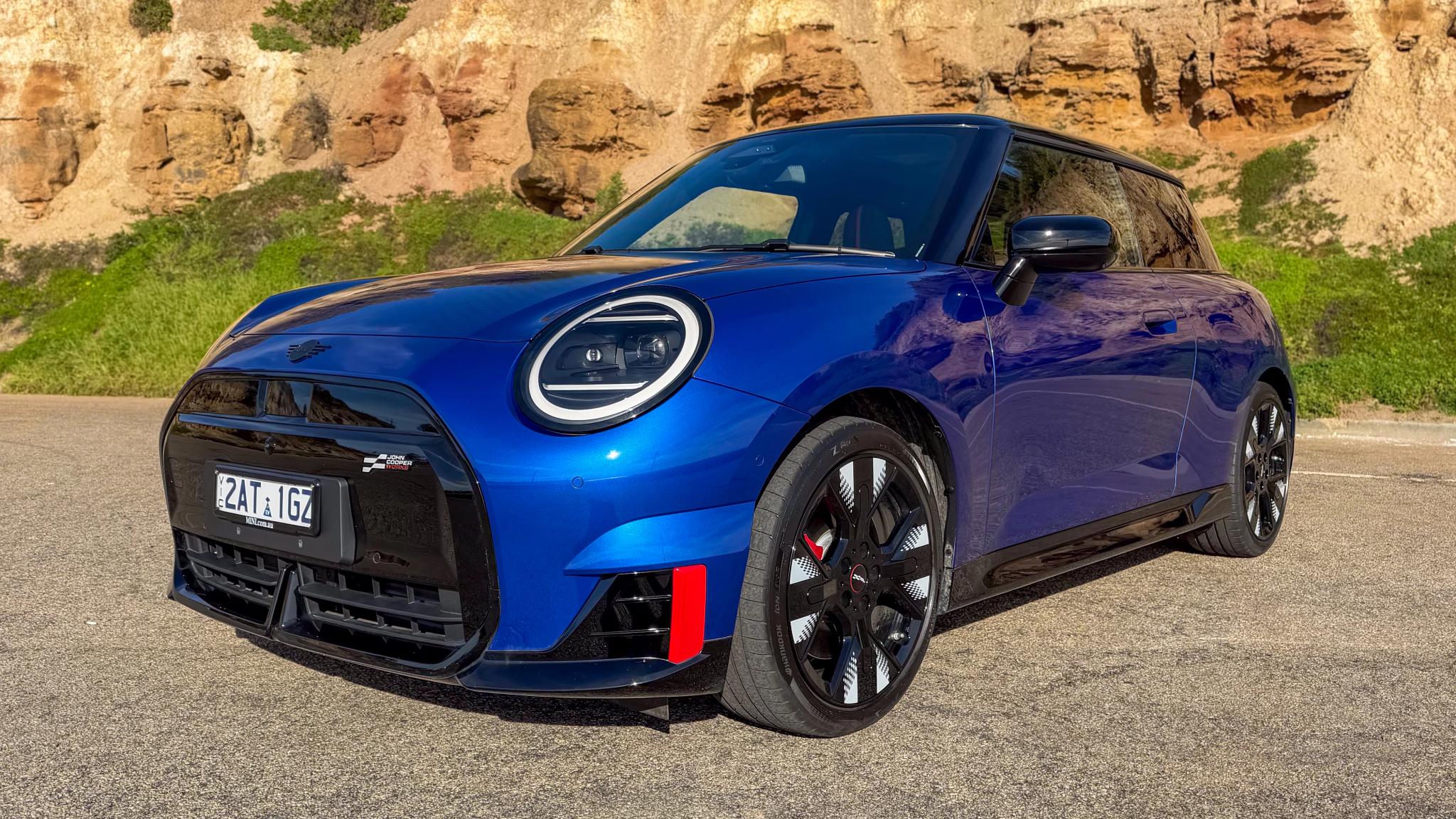
Mini's first electric John Cooper Works keeps the mischief, the flat cornering and the daft sound effects intact, but asks $63,990 before on-roads for a four-seat hatch with a 210L boot.

Rob Leigh
Pros
- Seriously quick and still playful through corners
- One of the best screens in the business, wrapped in a genuinely charming cabin
- Boost paddle turns a trip to the shops into an event
Cons
- Firm suspension with no way to soften it
- 371km of range is short for a car built to chase back roads
- Thousands more than the petrol JCW and quieter for it
Our verdict
The Cooper JCW Electric is for the buyer who wants a small, fast, loud-looking EV and has zero interest in being sensible about it. It corners flat, it fires out of bends with the sort of instant shove no petrol JCW can match, and the cabin is one of the more likeable places to sit at any price.
The catch is everything around that. You are paying around $70,000 driveaway and what you get is a four-seater with a 210L boot, a ride that never softens, and a range figure that will shorten your favourite drive.
What does the JCW Electric cost in Australia?
There is one grade, the JCW E Favoured, listed at $63,990 before on-road costs. That is a lot of money for a car shorter than a Mazda 2.
| Variant | Powertrain | Drivetrain | Price excluding on-roads |
| Cooper JCW E Favoured | Electric, 190kW, 371km | Front-wheel drive | $63,990 |
View Mini Cooper driveaway pricing and specifications →
The standard equipment list is at least complete. You get 18-inch alloys, LED headlights, a 240mm circular OLED touchscreen with wireless Apple CarPlay and Android Auto, augmented-reality navigation, a head-up display, a panoramic sunroof, dual-zone climate control, a 360-degree camera and Harman Kardon audio.
The problem is what sits either side of it. The Cooper SE Favoured covers most of that kit for $5,000 less and the petrol JCW is thousands cheaper again while weighing around 350kg less.
So you are not buying equipment here. You are buying 190kW, a body kit and the badge, and Mini knows exactly how much that badge is worth to the people who want it.
What does the JCW Electric look like?
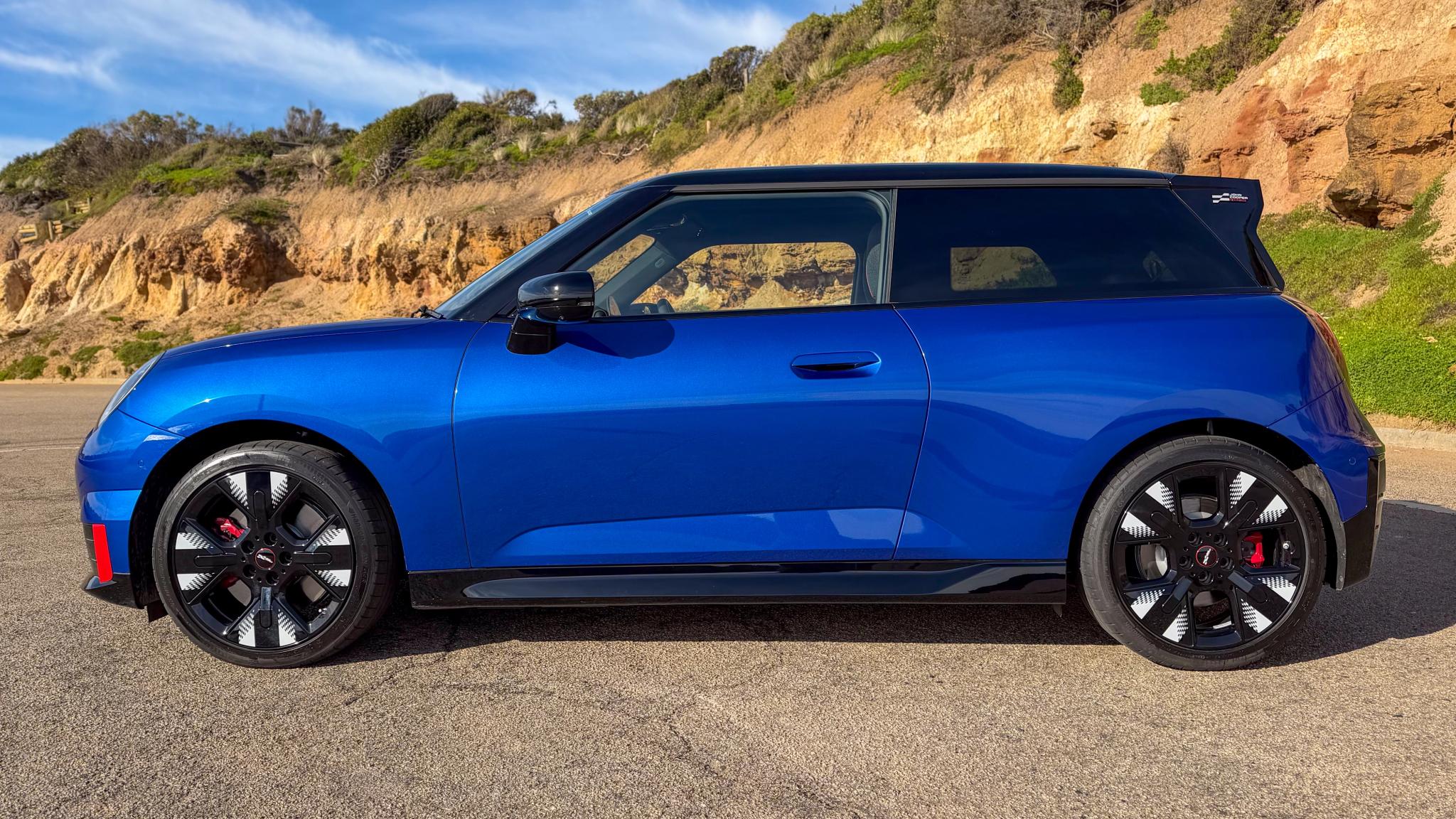
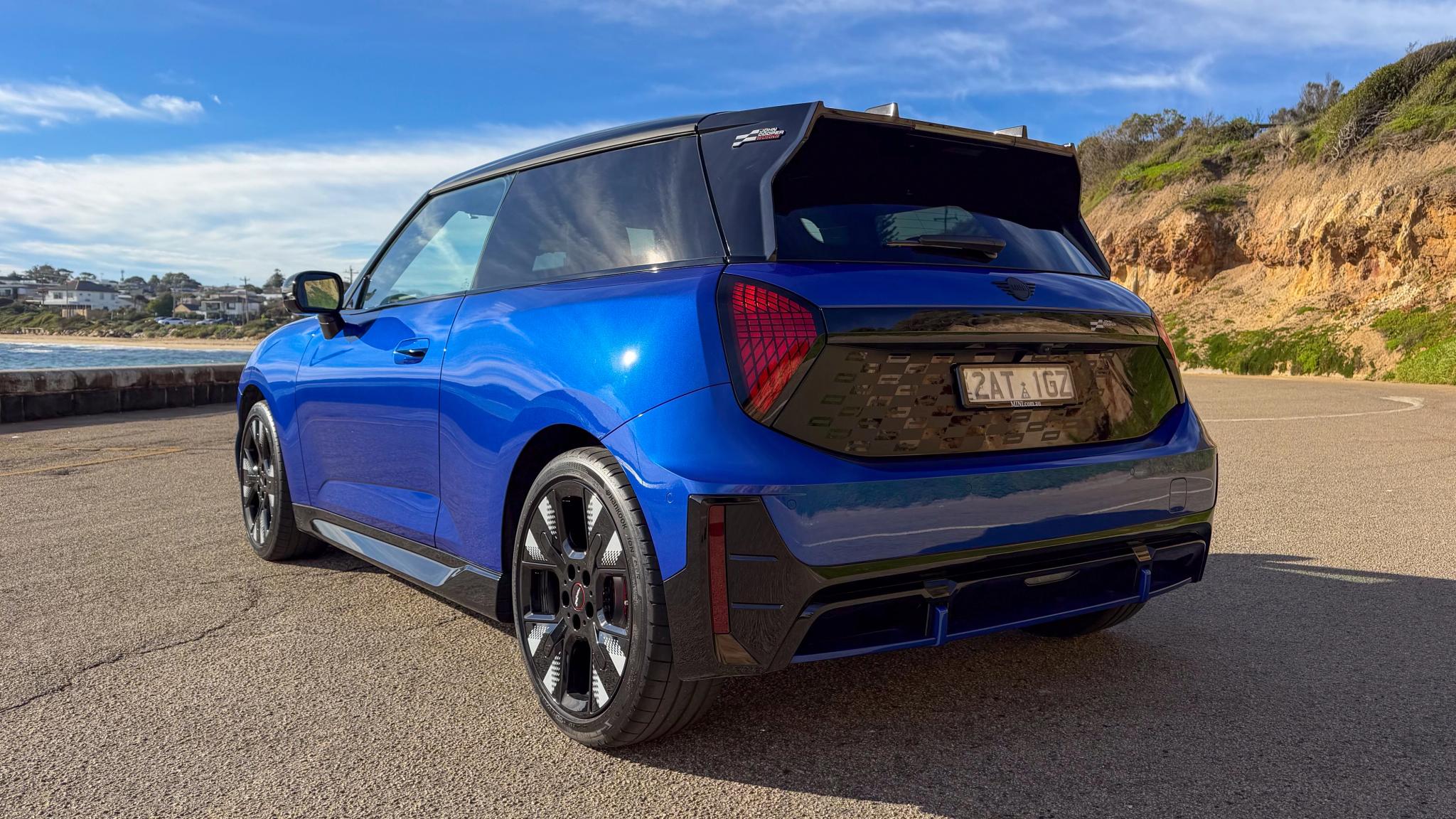
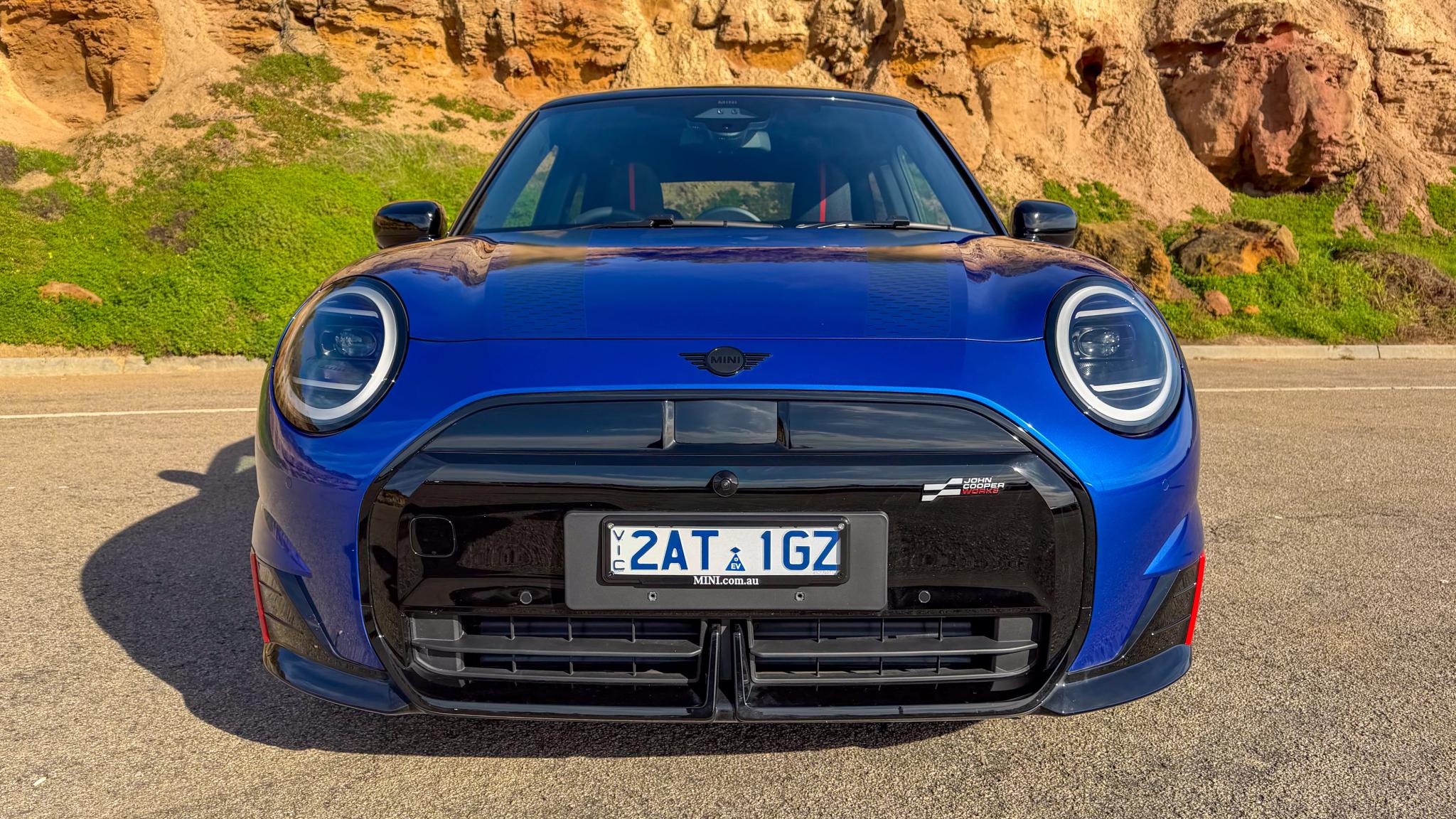
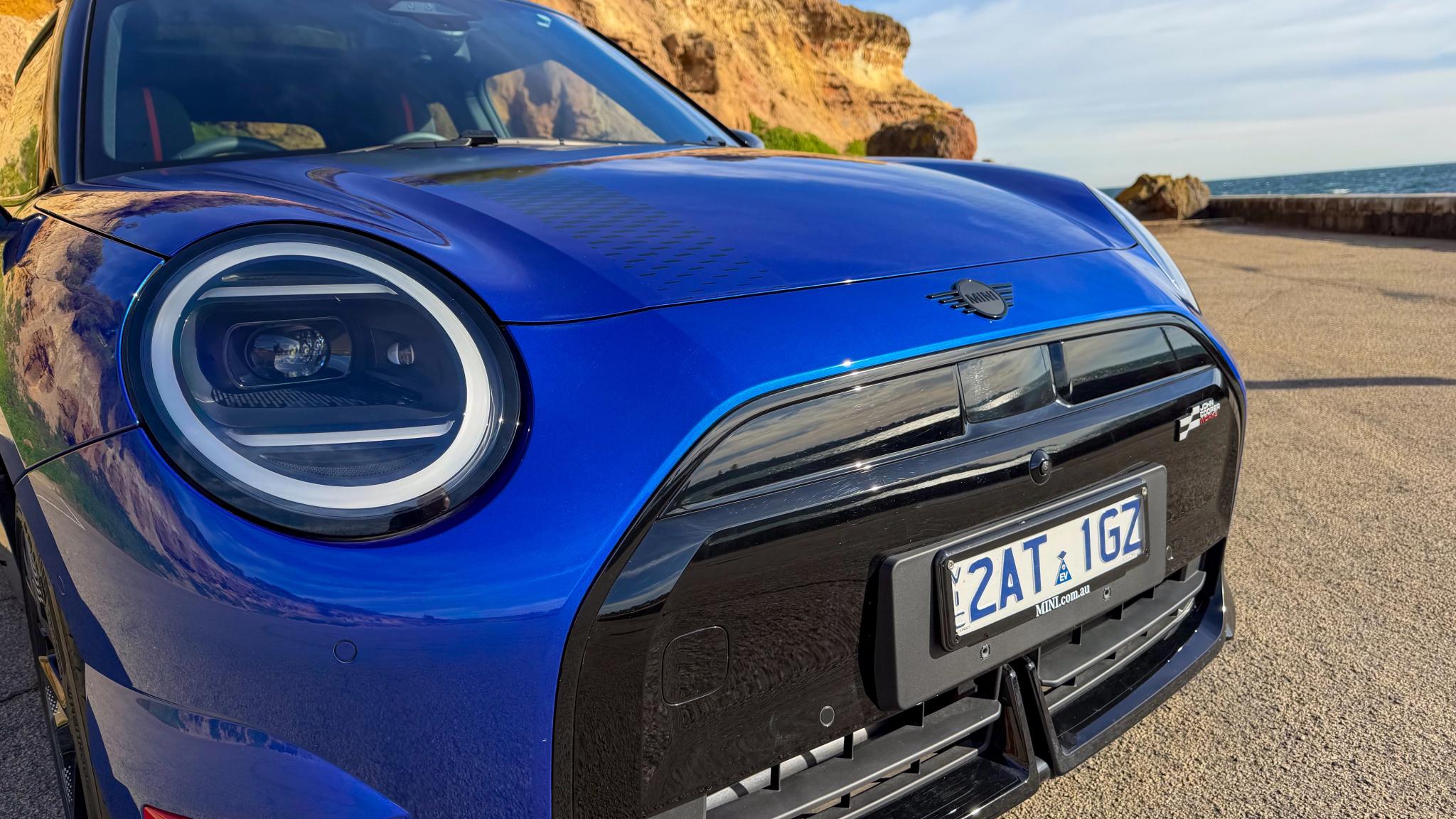
Mini has kept the electric and petrol three-door as close as possible visually, so the giveaways are small: pop-out door handles instead of hand-through ones, and none of the petrol car's black wheel-arch flares. Park them nose to nose and most people would need a second look.
The JCW treatment does the heavy lifting. There is a deeper front bumper, red accents through the grille and mirror caps, a contrasting black roof, chunkier 18-inch alloys and a rear diffuser that would look silly on anything less aggressive.
At 3,858mm long the Cooper is pretty small, and a small car wearing a serious body kit always looks better than a big one attempting the same trick.
What is the JCW Electric like inside?
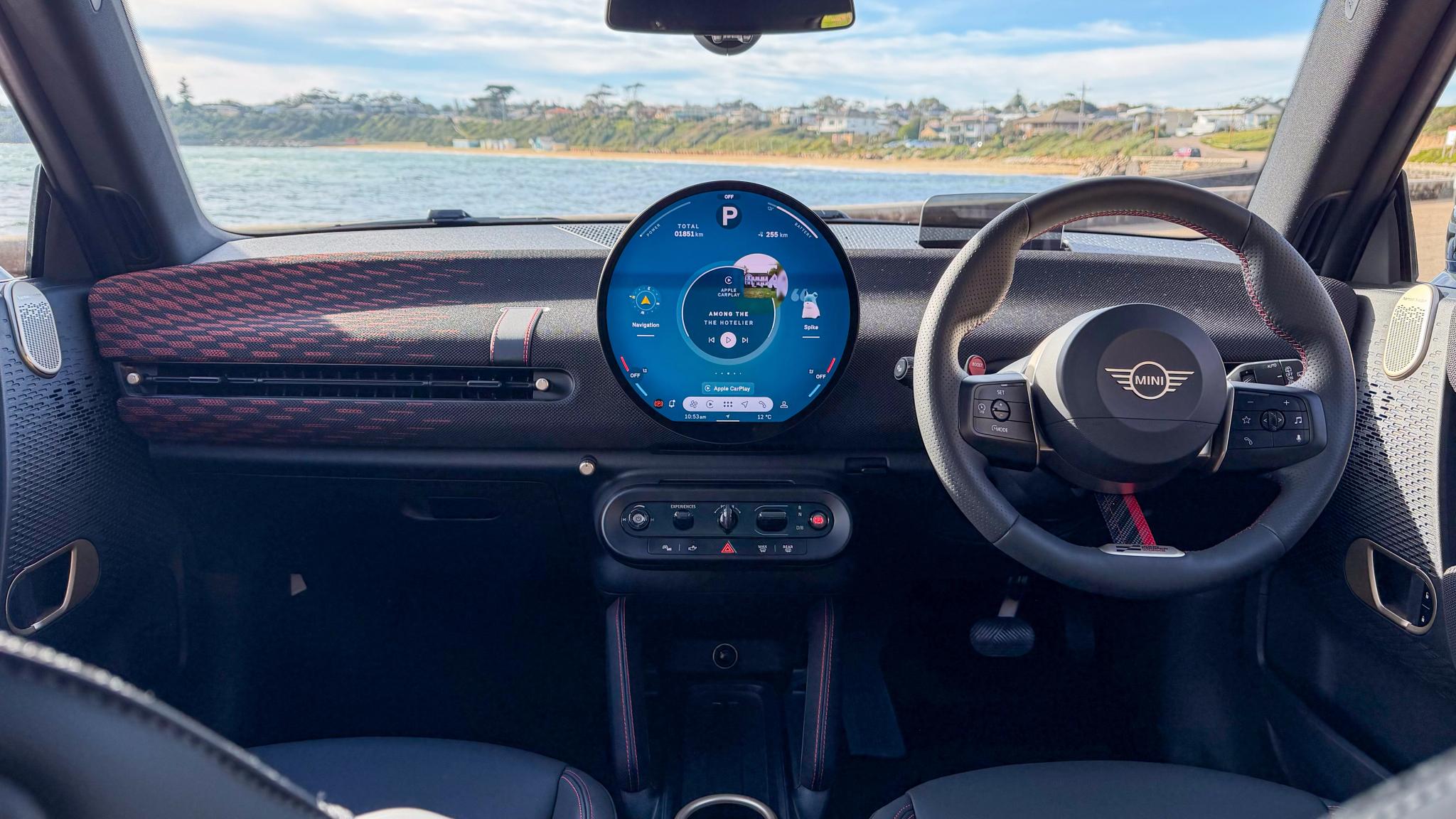
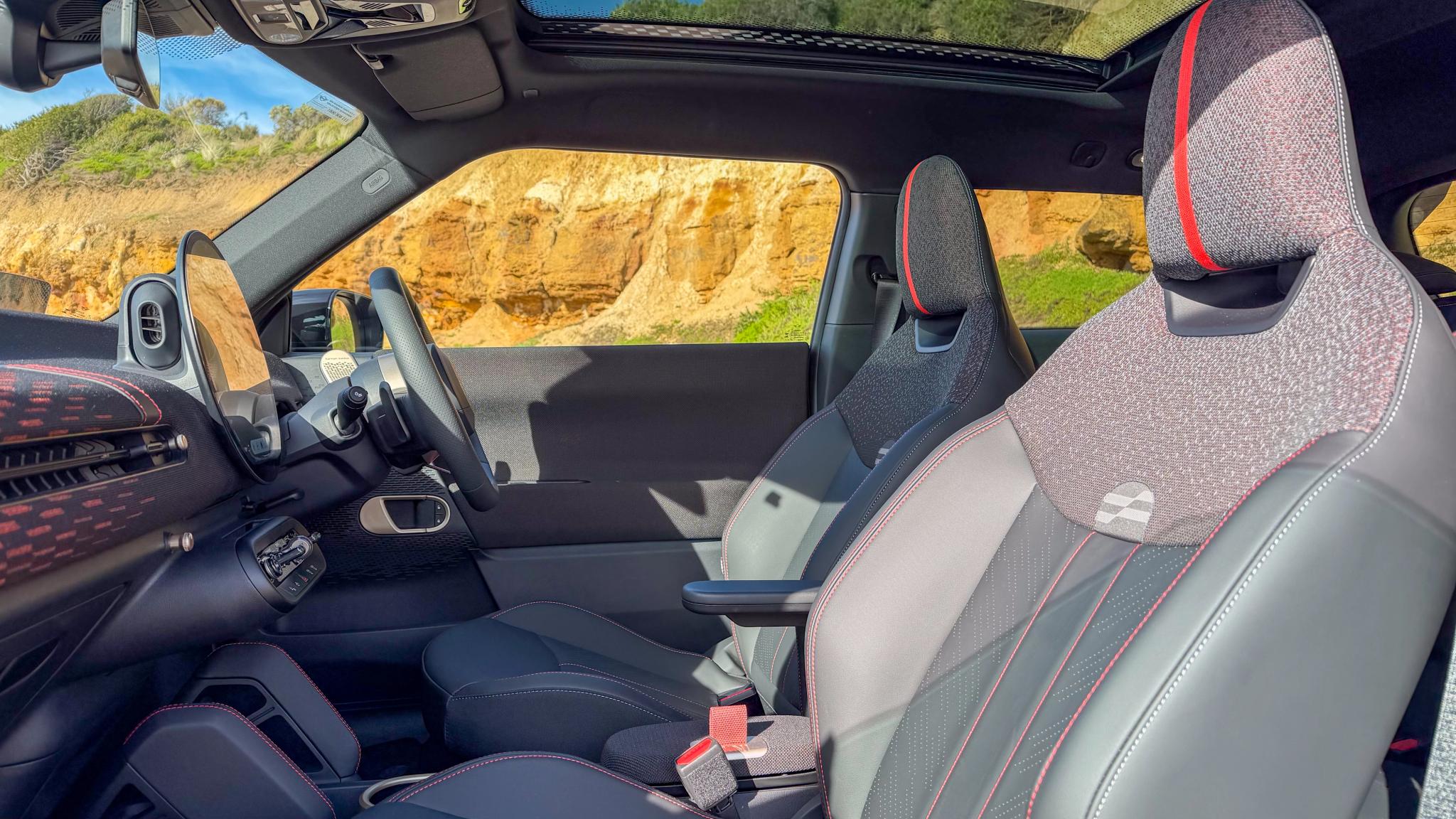
This is the best part of the car. Most of the dash and door tops are wrapped in a knitted fabric rather than plastic, the JCW version gets black and red with chequer detailing, and it feels far more considered than the price bracket usually delivers.
The circular OLED screen is the centrepiece and it is excellent, with sharp resolution, strong colours and animations for almost every function you touch. It is also doing too much, because the climate controls live in there behind sliders and sub-menus, and the only physical climate buttons are the demisters.
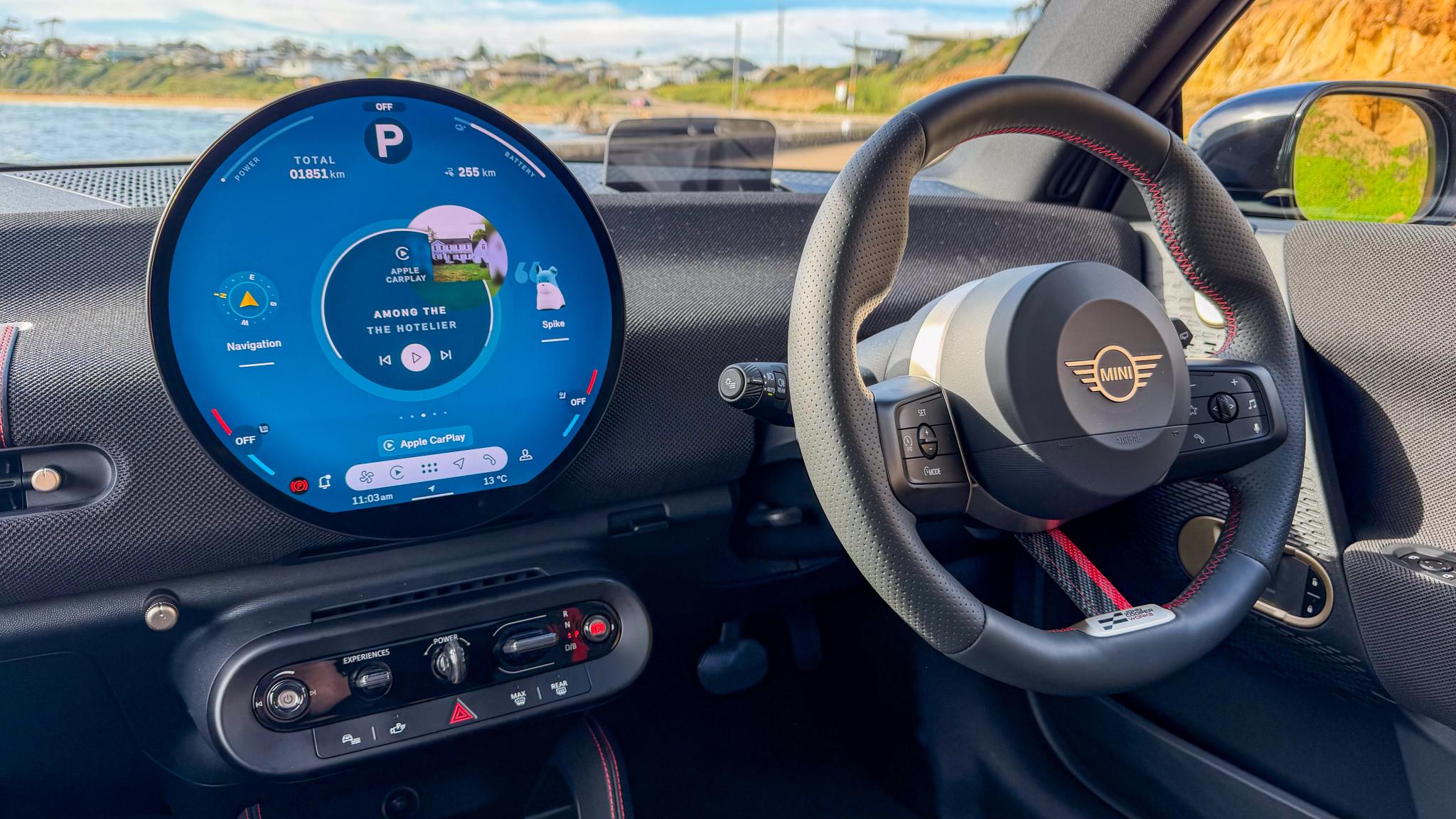
Underneath it sits a row of chrome toggles for starting the car, selecting drive modes and adjusting volume, which is exactly the sort of tactile switchgear the rest of the industry keeps deleting. The steering wheel is thick-rimmed with real buttons and a red Boost paddle, and there are no touch-sensitive pads to fumble at.
The driving position is spot on. You sit low, the seats are firmly bolstered with eight-way power adjustment and heating, and taller drivers get more head room than the exterior suggests.
Two gripes. The head-up display is the flip-up plastic type rather than projecting onto the windscreen, which feels cheap in an all-new car, and the fixed armrest hanging off the driver's seat looks like it was borrowed from an office chair.
How practical is the JCW Electric?
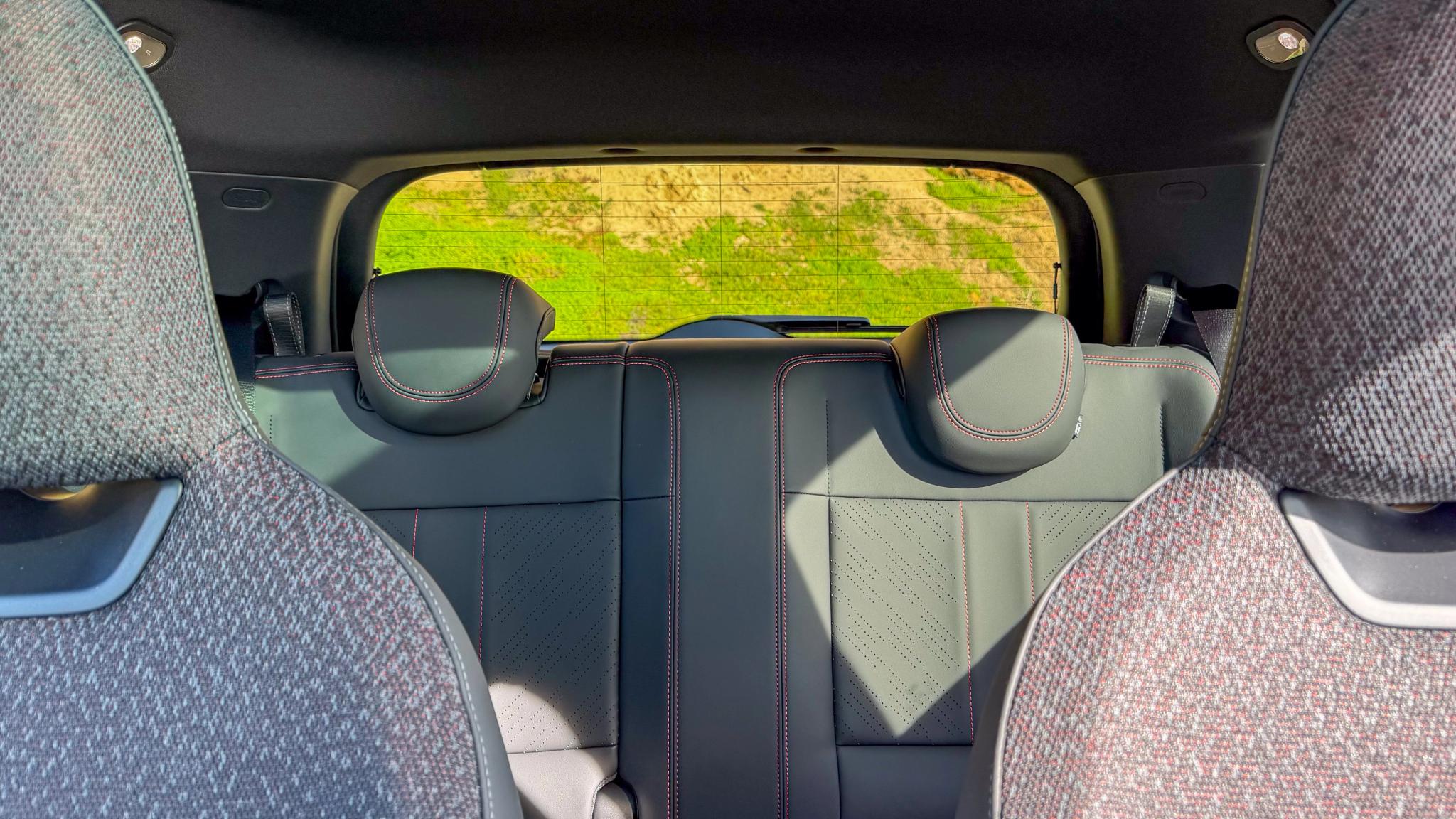
It is a four-seater and the two rear pews are best treated as occasional. There is a touch more knee room than the petrol Cooper thanks to the longer wheelbase, but anyone near 180cm will have their head against the roof lining.
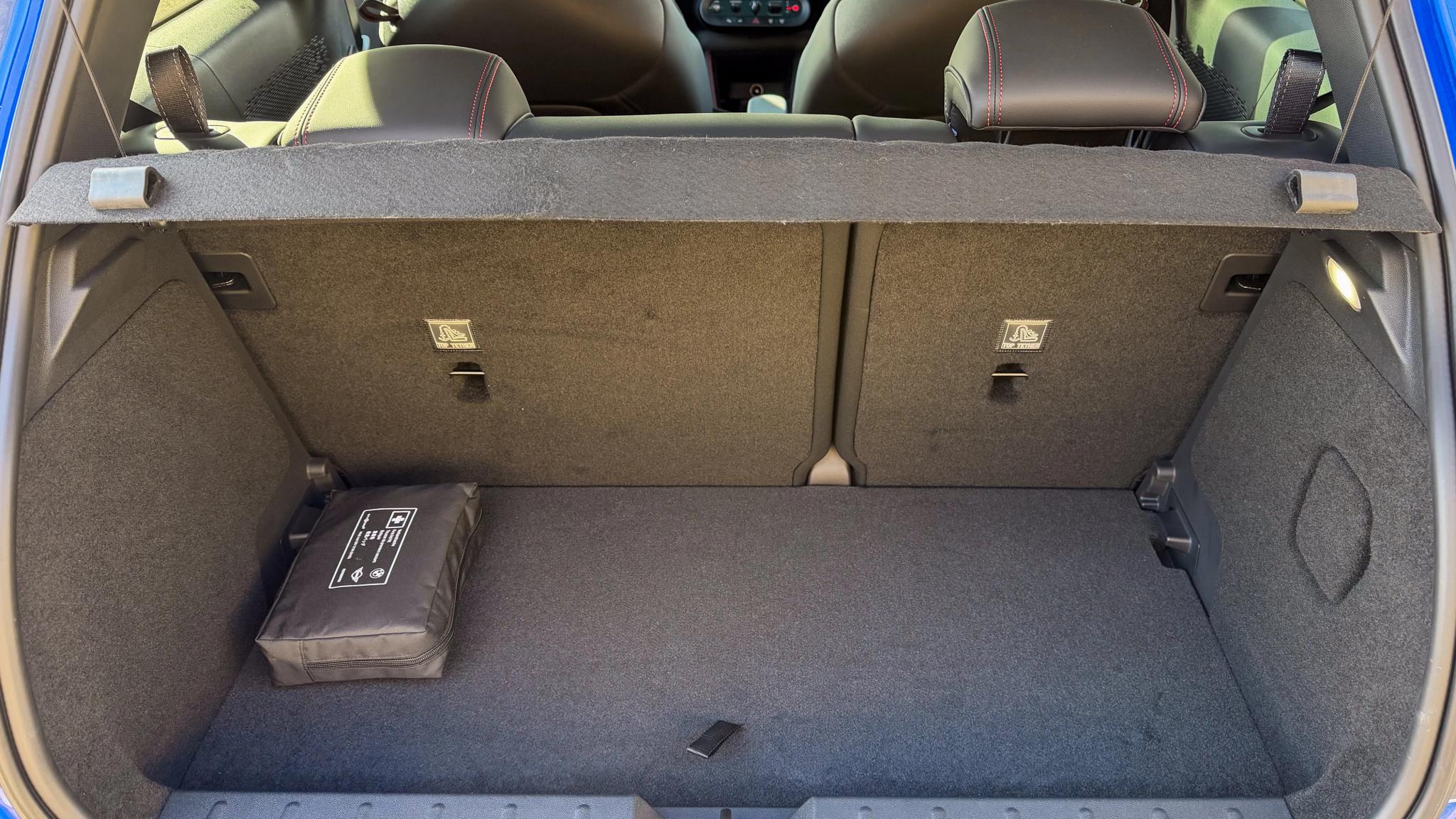
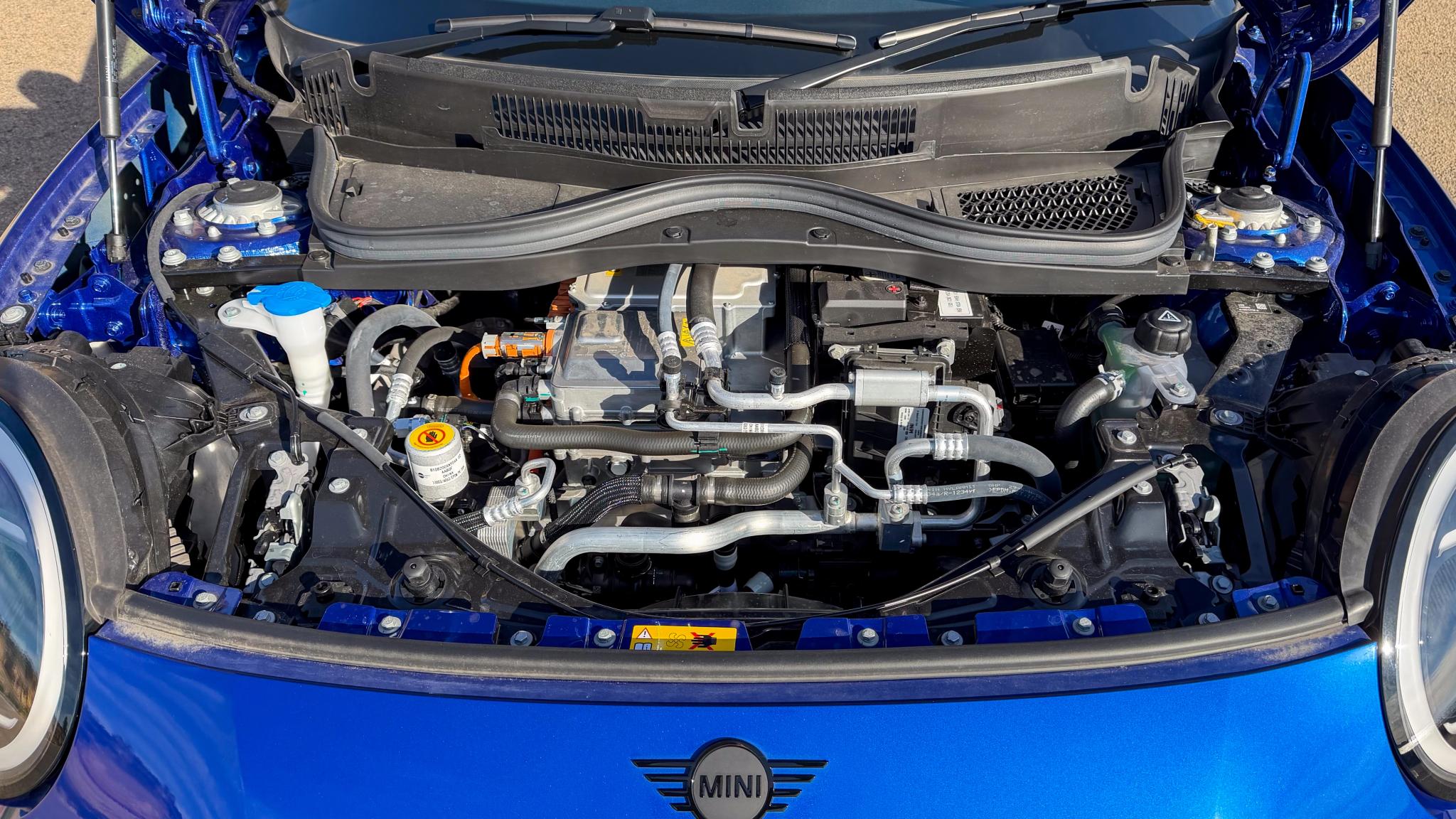
The boot is 210L, which is a couple of cabin bags and not much else, expanding to 800L with the rear seats folded flat. There is no under-bonnet storage, no spare wheel and only a repair kit, though there is some space under the boot floor.
Cabin storage is thin too. The glovebox is small, the door pockets will take a bottle lying down but not standing up, and the console bin opens towards the driver. Both ISOFIX and top-tether points are fitted, which is more optimistic than useful in a car this shape.
What is the JCW Electric like to drive?
Start with the suspension because it defines the car. There is no adaptive damping, deleted to save weight, so the springs and dampers are set hard and left there, and every expansion joint and patched-up back street comes through the seat.
Find a smooth, winding road and the firm setup starts to make sense. The body simply does not roll, the nose goes where you point it, and the whole car feels keyed up and impatient, nudging you to carry more speed into the next corner and then the one after that.
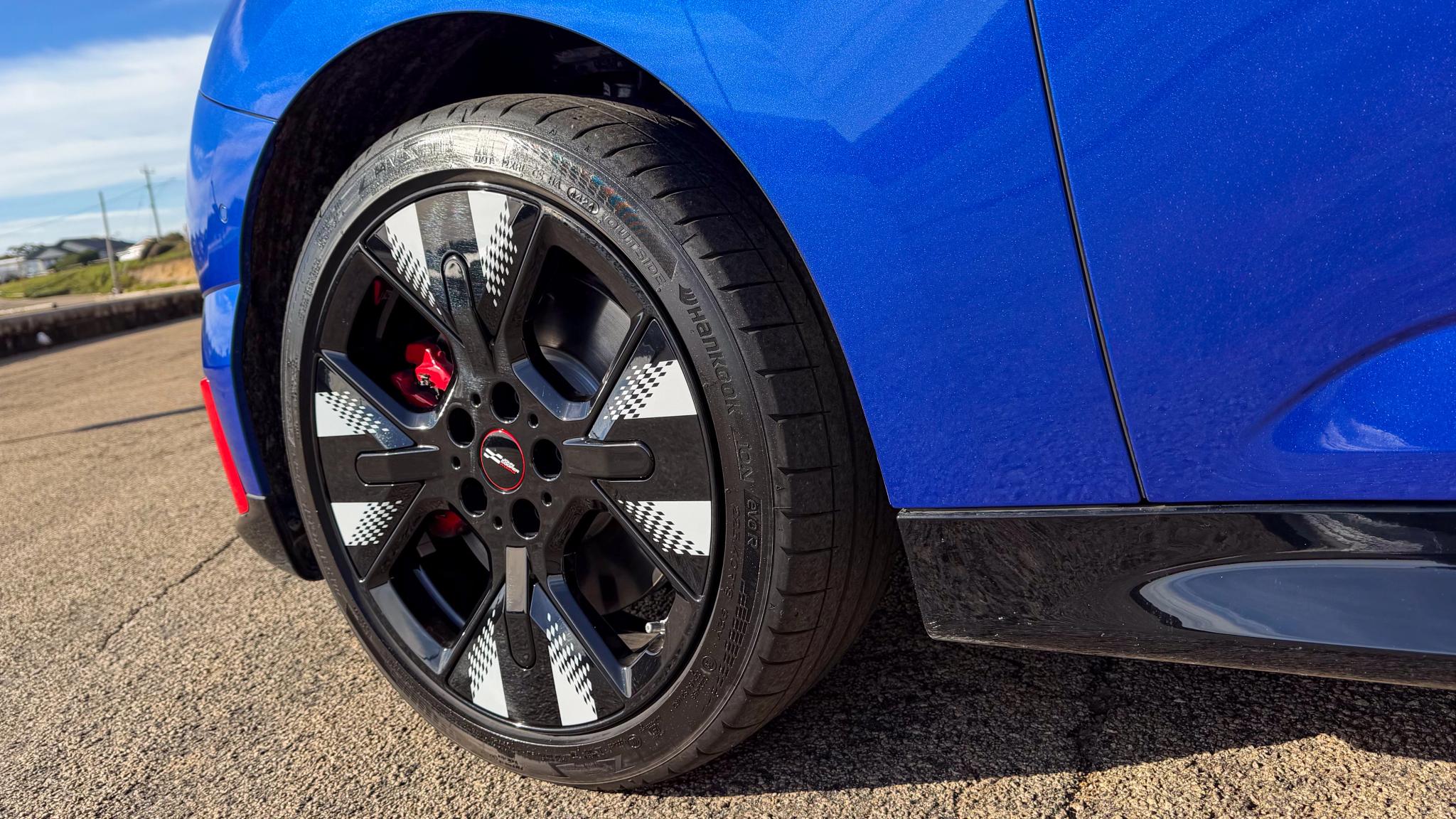
There is 170kW in the normal modes, 190kW and 350Nm in Go-Kart mode or when you pull the Boost paddle for 10 seconds, and 200kW with launch control armed. The quoted 5.9 seconds to 100km/h feels real and in a car this size it is plenty.
It doesn't hit as violently as you might expect from 200kW. It rolls on hard rather than punching you in the back, and the front tyres scrabble briefly when you flatten it out of a tight corner before the traction control sorts it out.
The Boost paddle is pure theatre and completely addictive. You pull it, the screen throws up an animation, everything sharpens, and you spend the next 10 seconds behaving like a teenager.
Steering is quick and nicely weighted, heavy just off centre in Go-Kart and lightening naturally as you wind on lock, though it tells you very little about what the front tyres are doing. Grip from the 18-inch rubber is good without being remarkable, and a proper limited-slip differential would let it use more of its power on corner exit.
At 1,650kg it is roughly 350kg heavier than the petrol JCW and it cannot fully hide that. You can feel the extra weight, but it also makes the car feel settled and secure at speed.
The synthesised soundtrack is the other talking point. It is more spaceship than four-cylinder, it fades when you lift rather than droning constantly, and it is either a highlight or the first thing you switch off. There is no middle ground, and Mini deserves credit for letting you choose.
Regenerative braking runs to three fixed levels plus an adaptive setting and a one-pedal B mode, and the blend between regen and the friction brakes is well judged. The brake pedal is softer than a hot hatch pedal should be, but it is easy to modulate.
How efficient is the JCW Electric?
The 54.2kWh battery (49.8kWh usable) is good for 371km on the WLTP cycle, down from 400km in the Cooper SE because of the stickier tyres and the harder-working motor. Encouragingly, that 371km is a number you can actually see in mixed driving rather than a laboratory fantasy.
Mini claims 13.8kWh/100km, which is frugal for something this sharp, though sustained enthusiasm will push it well past that. A 95kW DC peak returns 10 to 80% in about 30 minutes and an 11kW home wallbox takes a little over five hours from empty.
Servicing is condition-based, so the car tells you when it wants attention rather than working to a fixed interval. Prepaid service packs are also available to cover the first few years of ownership.
| Cover | Detail |
| Warranty | Five years, unlimited km |
| Battery warranty | Eight years, 100,000km |
| Service intervals | Condition based |
| Basic prepaid pack | $1,375 (four years) |
That battery warranty is the weak spot. Eight years is standard, but the 100,000km cap is well short of the 160,000km most rivals offer.
Is the JCW Electric safe?
The electric Cooper range carries a five-star ANCAP rating from 2025 testing with 89% for adult occupant protection, 83% for child occupant protection, 77% for vulnerable road users and 83% for safety assist.
Seven airbags are fitted, including a front-centre bag, and the driver assistance list covers autonomous emergency braking with forward and reverse operation, adaptive cruise with stop-and-go, blind-spot monitoring, rear cross-traffic alert with intervention, lane-keep and lane-centring assist, speed limit assist, driver attention monitoring and a door exit warning.
Better still, none of it constantly nags you from behind the wheel. The assistance intervenes quietly and generally stays out of your way.
What are the main competitors to the JCW Electric?
The Mini Cooper JCW is the purist's pick and the most awkward comparison of the lot. From around $58,000 plus on-roads it gives you 170kW and 380Nm from a 2.0-litre turbo four, around 350kg less mass, a noise you can actually hear and a chassis that changes direction more eagerly. The electric car counters with instant torque, a nicer cabin and running costs the petrol car cannot touch, but if outright involvement is the goal, the petrol one still wins.
The Mini Aceman in JCW form is the sensible version of the same idea, at around $65,990 plus on-roads. Same motor, same battery, but five doors, five seats and a 300L boot, at the cost of 95kg and a slightly slower 6.4-second sprint. Buyers who like the drivetrain but need to use the back seats more than twice a year should start here instead.
The MG 4 in XPower guise is the value option, from $47,990 driveaway with 320kW and 600Nm through all four wheels and roughly 400km of range. It is quicker for less money, but the Mini has the better cabin and feels much sharper from behind the wheel.
Cross-shopping generally comes down to the Mini against its own petrol sibling, with the Aceman JCW as the practical compromise.
Should I buy the JCW Electric?
If you want the most rational small EV at this price, no. The boot is tiny, the back seats are a formality, the ride never relents and the range will limit how far you chase a good road.
But nobody buys a JCW to be rational. Mini could have used electrification as an excuse to soften this car and make it polite, and it has done the opposite, building something firm, fast, a bit unhinged and absolutely committed to the badge.
That is the whole pitch. If you can live without the exhaust note, everything that made a JCW a JCW is still here, and there is very little else at this price with anywhere near as much personality.
VerdictThe Beep Verdict
Rob Leigh
Co-founder & Director
Rob Leigh is Co-founder and Director of The Beep based in Melbourne, Australia. He has 15+ years inside a major automotive OEM, specialising in product planning, pricing and vehicle strategy.
About Author